Showing posts with label politics. Show all posts

Sunday, 5 April 2009

Something from Malaysia

It seems that Datuk Seri Najib Razak, Malaysia's new PM, begins his office aiming for a big change.

Let me put into points; 
1) He will tackle the country's most controversial law, the Internal Security Act (ISA). This law allows detention without trial. He said the law needs to be reviewed. 

2) According to the law revision, 13 detainees will be released. These detainees are activists, members of political movements, or they were accused of something. Some of the detainees are leaders of the Hindu Rights Action Force (Hindraf), which raises vioce for the Indian minority in Malaysia.
 
3) He has lifted 3-month ban on the two opposition newspaper. 

Sure, this can be seen as nothing but a propaganda building up government's credibility. But if we are to be optimistic enough, we can see that what seems to be an important issue for this new PM is freedom of expression. 

According to the news, he said "It must be a government with new approaches for new times - a government that places a priority on performance because the people must come first

This might relect something to Malaysia's neihbour. 

"THE PEOPLE MUST COME FIRST" - A slogan of the Democrat Party, Thailand's political party. But how has this slogan been practiced? 

Let me put into points;
1) Not only one of the most controversial law of the country, the Lese Majeste, has been untouched, there is a potential to increase penalty on such law. Recently, Suwicha Thakor is going to jail for 10 years on Lese Majeste. Also, an Australian journalist has a lot to tell when he was in prison due to the same accusation. (New Mandala host a campaign on LM's reform in which you could find a lot of details) 

2) Prachatai.com, an alternative online newspaper, was raided and the editor, Khun Chiranuch, was arrested and charged with computer crime act (the news is here and a reflection is here). 

3) The Rohingya incident was still in public scrutiny, but not much has been done, only lip service from Thailand's PM. 

In terms of freedom of expression and human rights problems, I see Malaysia is hoping to get back on track. 

Sunday, 8 February 2009

Historic Asia visit: a reflection


Hillary Clinton is scheduled to visit East Asian countries including China, Japan, South Korea, and Indonesia. This will be her first overseas trip as the US Secretary of State. 

It is interesting that the US chose Indonesia as a destination to demonstrate its foreign policy in Southeast Asia. It can be seen that the superpower  is seeing Indonesia as a representative for the whole region. 

But why Indonesia? 

Of course, Barack Obama's childhood in Indonesia may be a factor. There is a personal link between the new US President and Southeast Asia. Or in other words, it made the US approach this region easier. 

But I don't think it is an important point.  

Lest not forget some facts about Indonesia. It is the world's largest Muslim-majority nation. Indonesian Muslims comprise of 15 per cent of the total Islam population in the world. This is a crucial point; the US under Obama would have to approach Muslim countries for talks and develop trade partnership. It cannot pursue a preemptive attitude like it once was under Mr.Bush. So where is the better place if not Indonesia? A tight relationship with Indonesia show the Middle-East that the US is willing to negotiate with any Muslim nations. This is for the sake of neo-liberalism, unfortunately. 

Moreover, let's consider Indonesia's performance since the economic bust in 1997. Among countries in Southeast Asia, Thailand and Indonesia were to two most severely hit by the crisis. However, ten years later, Indonesia under President Susilo Bambang Yudhoyono improved considerably well.  The conflict between religions seems to decrease. Even though he is struggling to gain real power in the administration, Yudhoyono seems to do well in his office. Compare to countries in the region, Indonesia is seen as the most promising.

P.S. It's the Shan's National Day on Saturday. 

Tuesday, 20 January 2009

Striking similarity

An audience of Abhisit, a new Thai PM, with the King reminds me of Thailand some fifty years ago. 

There is a criticism towards Abhisit that he should not sit on the same level as the King. However, it is believed that the position has been arranged beforehand. 

Which means something? 

Back in the late 1950s, Sarit used to sit at the same level as the King. I believe that some might have seen the picture. 

These two images, one from the 1950s and another from present, poses a striking similarity: After Sarit staged a coup in 1957, the power was brought back to the monarchy after it was challaenged by Phibun. 

At present, the power was brought back to the monarchy by "an invisible coup" led by the army leaders (e.g. Three "P"s and Big Bung) after it is believed that Thaksin regime brought it away  in the last 5-10 years. Abhisit is someone who will stablize the monarchy once again. 

However, as we all have known, today the development of democracy in Thailand has come to the point that political conflict cannot be solved in the same way as it used to fifty years ago. Take Lese Majeste law for example, the world desperately wants to know why Thailand still tighten such law when this is a crucial time to discuss about the role of the monarchy in the constitutional system. Ultimately, this law has been used as a tool to discredit, criticize, and attack political oppositions, rather than to stabilize the monarchy itself.  

What happend proves that while the stream of democray is moving forward, Thai authorities choose to halt the process of change. The mass would still have nothing in hand and cannot think for themselves, but to look upon the role model in order to rely their lives on. I think this is an unhealthy way of rasing your "children".     

It shows that Thailand seeks sudden change, rather than a smooth, non-violent one. 


Saturday, 22 November 2008

Historical Document (again)


The simple phrase to decribe the conflict that has been going on is "an eye for an eye, a tooth for a tooth". 

I've got another historical document which I think makes my collection better. The earlier post is from the PAD's perspective. This one is from UDD. 

Do doubt that these documents will be so valuable in the next couple of decades.


Tuesday, 21 October 2008

Historical documents


I recommend those who pocess anything concerning current political events (i.e. photos, documents, video clips, and so forth) to keep them as many as possible. For the next couple of decades, they will become valuable sources for the next generation. 

I don't believe those who say "time will prove one's guilt". For me, it depends on "who" hold the power at the time. Whether former PM Thanksin will become a hero or a villain, it's up to those who will be holding power to 'produce' knowledge or able to 'write' history legitimately. 

Also, do remember as many details as possible. One day you will have to pass this story onto the youngers. 

Be fair to every side. 


Friday, 17 October 2008

Hopes are fading?

More than 100 NLD youth resigned complaining that they can't participate in any potitical activities, The Irrawaddy reports

Are Southeast Asian youths no longer active in politics? 

I don't think so. They always ready, but the situation is not ripe yet.

Keep monitoring, youth of the nation.

Monday, 29 September 2008

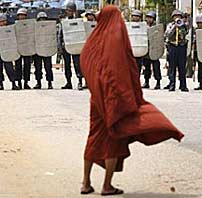
Anniversary of the Saffron Revolution


It has been a year since the Saffron Revolution. What happend thereafter? 
Myanmar suffered from cylone Nargis with more than 2ooK people dead. Aids from various international organizations were blocked and everybody (well, not sure about China) condemned the military govt. 

No response. 

The Nargis event was the most obvious and direct effect of how dictatorial leadership can cause disaster. If the regime is more relax on information, less people would suffer and the number would not be this high. Because media in Myanmar were restricted, people have not much chance to receive any information including the cyclone warning.  

We can see that people's voices are getting louder these days.  Let's hope that change will come soon. 


Tuesday, 23 September 2008

Parallel politics

I think Thai and Malay politics today have something in common. 

Situations show the struggle of power between two groups; those who tried to secure interests (because they feel threatened) and those who ask for a share, if not a replacement, of power. 

The problem is a classic: Resources are limited, so everybody must fight for it. 

Events in Thailand illustrate that the fundamental power is still strong (some scholars call it "bureaucratic polity", which I think quite problematic in the current context). The former PM - who now bases in London - is a good example. The consevative force support those who align themselves closely with it. However, it seems that the conservative force changed its appearance in many ways. (bluntly, it knows how to spend the money and spend it well!) 
This situation is reflected from Thai history when power could not be easily decentralized.

In Malaysia, the UMNO seem to have quite a problem because it does not hold as strong power as it used to. The development of parliamentary system is working in Malay politics this time.  UMNO does not have too many methods to secure popularity like the fundamental power in Thailand does. It is interesting to see how Anwar's parliamentary means will work this time. 

 Malaysia will experience a change in politics way sooner than Thailand.

Ps. Those who are interested in Southeast Asian literature and living in Thailand, go to see the introduction of Southeast Asian writers at the Thai National Library, Fri 26 Sept, 2pm 


Friday, 29 August 2008

A change to come

I don't think this government will last another month, to be the most optimistic.

With Thaksin fading from the scene, fractions among politicians are more visible than ever. We will now able to see the real opportunists stepping on the foreground of Thai politics.

I have one remark:
Since the 1970s, political conflict in Thailand has become less apprent in terms of ideology. That is, it is not the dictatorship VS democracy battle as it use to be in the last half century. Rather, democracy became an instrument for some groups to use as means to power.
Now you can see artists, poets, and musicians who opposed the military government in the 1970s turn to oppose the elected government.

I wonder...is this just manipulation?

Ps. If anyone wants to catch up, Bangkok Pundit provides the best current situation in English.

Friday, 8 August 2008

8-8-88


Twenty years ago, Burma went through a situation in which is still debatable today whether it was "hope" or "failure".


Suu Gyi's National League of Democracy (NLD) was established and won the election over the SPDC. But the result was cancelled by the army.


Today, many countries are pressuring Myanmar. But as we can see, nothing has changed much.


According to Mary P Callahan's new monograph, maybe we might see a change sometimes soon?


I mourne to those who lost their lives in 8-8-88.

Wednesday, 23 July 2008

Where is the way out?


Thailand is facing a very hard time politically and economically like her neighbours in the region. The country is divided between the PAD and the anti-PAD group which turns out to be more and more violent. As far as analyses from various sources go, the way out of this complex situation would not appear easily.


Political movements on the street involve a large amount of 'capital', either money or ideology. The sad thing is: all these movements serve the purpose of only a small group of people.


What a shame.

Monday, 2 June 2008

The vicious cycle of politics

To be honest, I don't want to talk about the current political situation that much. As a historian, it is too early to analyze. Let this be an exception.

The PAD has come out to the streets again. Nothing new. Somehow I agree with those people who condemn the media for making this matter too salient.

I cannot understand why the PAD's supporters do not see what is the most urgent matter for the country. Prices are roaring, don't expect that the new government can make everything better overnight.

I tell you; whether you guys win or loose, you will be suffered, not your leaders. Those people are getting even richer from this situation.

You are being used!

Ps. However, I don't think they will succeed. No support from above.

Thursday, 29 May 2008

A change from Nepal

Finally, Nepal has become the world's newest republic after a majority of constituent assembly has voted to abolish the 240-year-old monarchy. A brief news is here.

What does this situation tells us?

It depends on how the rulers rule their countries, no matter what kind of regimes there are. The country would still be, more or less, stable as long as the people are happy i.e. having money in thier pockets.

This leads me to think that: At the end of the day, is the rightest regime really a regime, or a management of people's selfishness? Do people actually need any kind of regime or they just want the ruler to make them prosper?

I think it is too extreme. Because if everyone's selfish, how can we instill a sense of public responsibility to the people?

What does it take to make a change?

The ruler, or the people?

Thursday, 8 May 2008

Military Rules in Southeast Asia

Whilst I am studying for the exam, a question emerged on the topic about the military rule in Southeast Asia.

In 1960s many countries in the region were ruled by military cliques; Burma under Ne Win; Thailand under Thanom; Indonesia under Suharto. It looks like these countries were moving into an "effective body of administration" after the chaotic period that preceded it.

Basically, because the army had arms, it then pocessed coercive power which by that time was the most effective way to control the restless situation under the shortest time being. However, more importantly, some groups gained interest from being involved in the politics; military regimes were main investors in Burma and Indonesia during the time. In Thailand, the leaders seemed to enjoy a personal interest from US aid programme especially the Military Assistant Programme. That is why they still wanted to cling onto power.

What about the west? or What about those countries that mil. has divorced from the government already?


Tuesday, 6 May 2008

Lese Majeste charges against Chotisak.

I think what Chotisak is doing is too early, too soon. There are other methods he could adopt rather than not standing up in the cinema. I am not saying that he hasn't have the right to do it but he fails to realize that the other side could turn violent on him. Too risky.

If talking about "The King Never Smile" is still being banned, you are not doing it in the right time, Chotisak (and others). Wait first, the situation is not ripe yet.
Ps.
- I mourne for those who has lost thier lives in Burma due to the cyclone Nargis. The number is here.
- I see two changes in the world today:
1) Olmert and Abbas are moving towards easing Israeli-Palestinian tension.
2) Hu Jin Tao is scheduled to visit Japan.

Tuesday, 18 March 2008

"Morality" and Thai politics

There are many disscussions about 'morality' and Thai politics today. I have watched Chu-Pitch TV in Prachatai.com the other day, Ajarn Pitch talked about the role of morality and Thai politics.

Ajarn Pitch focused on morality(Sin-la-tham) in democracy. He says that democracy is the system to manage 'selfishness' of the people(I agree with this Hobbsian approache) and to tell whether there is any morality in domocracy, we have to see how much can the elected represent the need of the people. He concluded that, in this regard, it is possible only to see morality 'inside' or 'outside' politics.

Morality in Buddhist notion will not be discussed in this context.

Just like Ajarn Somsak's article on the lastest Matichon Weekly about Pridi's project to legalize and set up casinos at Thai's border in 1938. Because the state had demolished some kind of tax, which would cost a big loss. Therefore, Pridi decided to build casinos to generate income for the state.

Ajarn Somsak also argue that talking about morality in Buddhist notion in present context is not pragmatic.

Nowadays, so many people are talking about morality(Buddhist notion) in politics. Which is a very subjective topic to find the ground.

Let's stick to something touchable.

Tuesday, 11 March 2008

Which road it leads to?


The election result from Malaysia makes me think of what's going on in Indonesia.
If anyone can remember, in Nov 2007, Indonesia won the Democracy Awards from International Association of Political Consultants (IAPC) for its progress toward democracy for the past nine years. An interesting thing is, usually this award will be given to individuals e.g.Nelson Mandela, Aung San Suu Kyi, etc. But this time, it is given to the entire nation!

Yeah, since its independence in 1945, this might be the time that can be called the 'calmest' period so far. But the diversity and, especially, the uneaqual policies from the state could possibly lead to a grave situation.

In Indonesia, Shariah Law could create fractions among the people. Even though 90 per cent of the population is muslims, but the majority of people are moderate, not fundamental. Is it a time to reconsider since not that many poeple are recieving a benefit form it?

In Malaysia, Bhumi-Putra policy stemmed from biases against the other races. But it was understandable from the context in history.
But at present, isn't it the time to reconsider? Isn't the election result starting to prove something?
So, what are these policies lead to?
I hope the answer is peace.
Ps. Irawaddy magazine had an interview with "Ad Carabao", a famouse Thai singer, on his support to free Shan State here.

Sunday, 9 March 2008

'Niras' Bangkok


"Niras" is one kind of Thai poem. It is composed when a poet has left the place where he belongs.

I wonder if Khun Thaksin writes a niras, what will he put into each line?

Grief, Sorrow, Anger, Pitiness, Forgive, Unforgive, etc.

His action at Suvarnabhumi airport was interpreted into a thousand ways. Scholars, Sympathizers, Supporters, opponents, etc. shared their opinions in many places including newspapers, TV, radios, and websites.

A family reunion after a year and six months.

After this, he will spend times fighting in courts. Meanwhile, Thai politics will be more and more interesting.

Gosh, I still wanna know who killed the people in the New Year bombing 2006!
Ps. I saw this in Asia Portal, it's about the 2006 coup and beyond. Interesting.