Monday, 29 September 2008

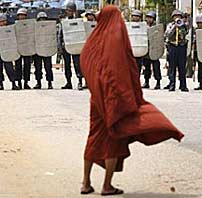
Anniversary of the Saffron Revolution


It has been a year since the Saffron Revolution. What happend thereafter? 
Myanmar suffered from cylone Nargis with more than 2ooK people dead. Aids from various international organizations were blocked and everybody (well, not sure about China) condemned the military govt. 

No response. 

The Nargis event was the most obvious and direct effect of how dictatorial leadership can cause disaster. If the regime is more relax on information, less people would suffer and the number would not be this high. Because media in Myanmar were restricted, people have not much chance to receive any information including the cyclone warning.  

We can see that people's voices are getting louder these days.  Let's hope that change will come soon. 


Tuesday, 23 September 2008

Parallel politics

I think Thai and Malay politics today have something in common. 

Situations show the struggle of power between two groups; those who tried to secure interests (because they feel threatened) and those who ask for a share, if not a replacement, of power. 

The problem is a classic: Resources are limited, so everybody must fight for it. 

Events in Thailand illustrate that the fundamental power is still strong (some scholars call it "bureaucratic polity", which I think quite problematic in the current context). The former PM - who now bases in London - is a good example. The consevative force support those who align themselves closely with it. However, it seems that the conservative force changed its appearance in many ways. (bluntly, it knows how to spend the money and spend it well!) 
This situation is reflected from Thai history when power could not be easily decentralized.

In Malaysia, the UMNO seem to have quite a problem because it does not hold as strong power as it used to. The development of parliamentary system is working in Malay politics this time.  UMNO does not have too many methods to secure popularity like the fundamental power in Thailand does. It is interesting to see how Anwar's parliamentary means will work this time. 

 Malaysia will experience a change in politics way sooner than Thailand.

Ps. Those who are interested in Southeast Asian literature and living in Thailand, go to see the introduction of Southeast Asian writers at the Thai National Library, Fri 26 Sept, 2pm 
  

Saturday, 30 August 2008

Thailand's S.E.A Write Awards 2008

Congratulations to Watchara Satchasarasin's (วัชระ สัจจะสารสิน) short stories "เราหลงลืมอะไรบางอย่าง" [We have forgotten something] on winning Thailand's S.E.A. Write Awards 2008

Ps. A review from Laughable Love's blog might give you some idea. Unfortunately, it's in Thai.


Friday, 29 August 2008

A change to come

I don't think this government will last another month, to be the most optimistic.

With Thaksin fading from the scene, fractions among politicians are more visible than ever. We will now able to see the real opportunists stepping on the foreground of Thai politics.

I have one remark:
Since the 1970s, political conflict in Thailand has become less apprent in terms of ideology. That is, it is not the dictatorship VS democracy battle as it use to be in the last half century. Rather, democracy became an instrument for some groups to use as means to power.
Now you can see artists, poets, and musicians who opposed the military government in the 1970s turn to oppose the elected government.

I wonder...is this just manipulation?

Ps. If anyone wants to catch up, Bangkok Pundit provides the best current situation in English.

Friday, 8 August 2008

8-8-88


Twenty years ago, Burma went through a situation in which is still debatable today whether it was "hope" or "failure".


Suu Gyi's National League of Democracy (NLD) was established and won the election over the SPDC. But the result was cancelled by the army.


Today, many countries are pressuring Myanmar. But as we can see, nothing has changed much.


According to Mary P Callahan's new monograph, maybe we might see a change sometimes soon?


I mourne to those who lost their lives in 8-8-88.

Tuesday, 29 July 2008

History repeats itself.

This is the first time I update my blog outside my home. I am at Siam Square, a place where all the Thai teenagers hang out.

I sit in the middle of the crowd. My mind drifts to so many places I shouldn't have. I should spend my time thinking about something not serious, right? No; My mind says.

News about political 'clean up' runs across my eyes. If you learn history well enough, you will see that history repeats itself.

However, I don't mean that we can predict what is going to happen. Instead, things can happen in a different form but still contain the same essense.

A clique who is holding a power will not let anyone invade thier 'territory of interest'.

It's the same everywhere, though a different form.

We must be able to see the truth behind it.

Wednesday, 23 July 2008

Where is the way out?


Thailand is facing a very hard time politically and economically like her neighbours in the region. The country is divided between the PAD and the anti-PAD group which turns out to be more and more violent. As far as analyses from various sources go, the way out of this complex situation would not appear easily.


Political movements on the street involve a large amount of 'capital', either money or ideology. The sad thing is: all these movements serve the purpose of only a small group of people.


What a shame.

Saturday, 21 June 2008

Was it just a dream?

Will ASEAN countries be like they were in the 1980s?

Robert McMahon observes that ASEAN was one of the "most dynamic area" in world economy back in the eighties.

Of course, there are many factors that made ASEAN become a gold pot; Cold War, the U.S. involvement, industrialization, and so forth.

Was it just a dream?

Thursday, 12 June 2008

What do we do?

The world is facing an economic stagnation and Southeast Asia is no exception. Oil and commodity price are roaring.

What do Southeast Asian governments do?

Thailand and Indonesia are having quite a similar policy to help poor people by reserving some goods i.e. rice to sell to the poor cheaply. Indonesia is going to have rice-for-poor packages to sell and Thailand is having "blue-flag" project by reserving some goods to sell at the price lower than the market rate.

My first question is: who are the poors?

and my second question concerns economic perspective: Does this distort the market machanism?

Ps. Malaysia's PM announced that the oil price in Malaysia will not increase again for the rest of the year. I don't think it is possible.

Tuesday, 10 June 2008

Good Governance in Developing Countries


I have attended Prof.Mushtaq H. Khan's inaugural talk today. He talks about "good governance" in developing countries.

He argues by casting doubts on the issue about wheather good governance is either achievable or necessary for developing countries in order to have economic developement. There is no country in history that has been through this process; by having a good governance an then follow by economic development.

He concludes that each country has its own particular kind of patron-client relationship and needs to be reformed in a particular way.

Throwing somewhat a vague concept calls "good governance" to those countries cannot make their economic develop.